


News

Tech for Hope
A youth-led technology trip supporting underserved women and children in Dar es Salaam. Through corporate partnerships, the trip delivered essential devices, food, and sanitary kits while offering digital literacy workshops to reduce gender-based barriers in education, health, and daily life.

Stories of Osterbay
A multimedia initiative that amplified the real voices of Tanzanian beneficiaries through 10 bilingual shorts (8,500+ views each), the digital exhibit “1 Painting, 100 Stories” (50 artworks, 10,000+ views), and a 1.5-hour webinar for 300+ Vietnamese students. The program raised $1,200 for education and gender equity — proving that storytelling can build both empathy and action.

<Tech for Hope> Charity Trip


There was a moment I still remember clearly — a little girl in Dar es Salaam curved her fingers over a tablet as if it might disappear. She didn’t say much, but her eyes widened every time a screen lit up. That was when I understood: giving technology is not just giving tools. It is giving permission to dream.
“Tech for Hope” began with that idea. With support from Halotel – Viettel Tanzania and a few partners who believed in the same future, we brought $2,400 in devices, food, and sanitary kits to over 250 women and children affected by poverty, disability, and COVID-19.

We held small workshops on basic digital skills, how to search for jobs, how to manage money, and how to stay safe online. Most participants had never touched a digital device before. Some mothers quietly took notes. Some girls asked whether learning English online could help them change their lives. Nobody raised their voice, but you could feel a shift in the air — as if the room had grown a little bigger, and hope had more space to sit.
We did not “teach” much. We mostly listened. One woman told us, “I never thought technology could belong to someone like me.” I wrote that sentence down in my notebook on the way home. I still carry it with me.
Tech for Hope did not end with a delivery. It began with a question lingered in my mind —
'What can change when people are given the chance to learn?'


<Stories from Osterbay>

Stories from Osterbay grew from stillness — from listening closely, writing slowly, and holding someone’s story with care.
During my time working with Upendo, I spent many afternoons in Osterbay speaking with children and caregivers at local centers. Their stories were soft at first, the kind that live behind the eyes rather than in spoken words. To honor them, I created 10 bilingual short stories, each one shaped from interviews, shared memories, or quiet observations. Every episode later reached 8,500+ views, carrying Osterbay’s voices far beyond the neighborhood.
Growing from that series, we curated 1 Painting, 100 Stories, an online exhibition of 50 artworks paired with community interpretations. Each piece invited viewers to reflect on resilience, childhood, and belonging. Over 10,000 people visited the exhibition, many sending messages about how a single painting stayed with them long after.
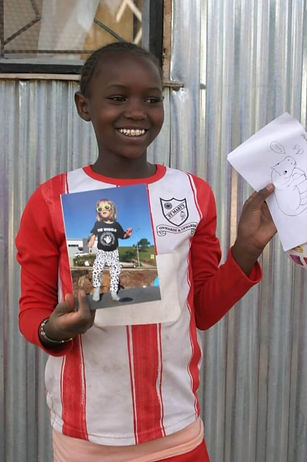


To bring this project off-screen, we hosted a 1.5-hour webinar with over 300 students, opening a space to discuss Tanzanian youth challenges, artistic expression, and cross-cultural understanding. What I remember most was the silence in the room — not an empty silence, but the kind that appears when people are trying to absorb something important.
Through writing, art, and conversation, “Osterbay” became a bridge. A reminder that storytelling is a form of care. And sometimes, the simplest act — giving someone the space to be heard — becomes its own kind of change.

<Colors of Africa>


Colors of Africa began with a simple wish to bring a piece of Tanzanian culture into a Vietnamese setting. Over two days, more than four hundred students and community members stepped into a room filled with music, open curiosity, and the soft buzz of people discovering something new together. Nothing felt staged or formal. The atmosphere grew naturally, shaped by rhythm and by the joy of moving side by side with people who slowly felt less like strangers.
I led the Afrobeats and Kizomba workshops, guiding around fifty participants through movements that were new to many of them. At first, the room was quiet in the way people get when they are unsure of their own bodies. But once the music settled, shoulders dropped, steps widened, and laughter broke the stiffness. The workshops became less about learning choreography and more about enjoying the freedom of moving without judgment.


At a quieter corner of the venue, we ran a handwritten letter station for Tanzanian girls facing challenges in staying in school. Our goal was to gather three hundred letters. Students took their time, choosing their words with care. Some wrote simple encouragements, others shared stories from their own lives. Even without meeting the recipients, they wrote with a sincerity that felt deeply moving.
Throughout the event, people drifted between dancing, writing, and talking. Small conversations formed about culture, education, and the lives of girls in Tanzania. Nothing was forced. The connections grew on their own. By the end, Colors of Africa felt less like a fundraiser and more like a meeting point where two cultures could sit beside each other and feel understood.
The most lasting part of the event was the quiet shift in the room — that soft recognition that empathy can grow quickly when people are willing to step into a new rhythm together.